Designing across map use contexts: a research agenda
Abstract
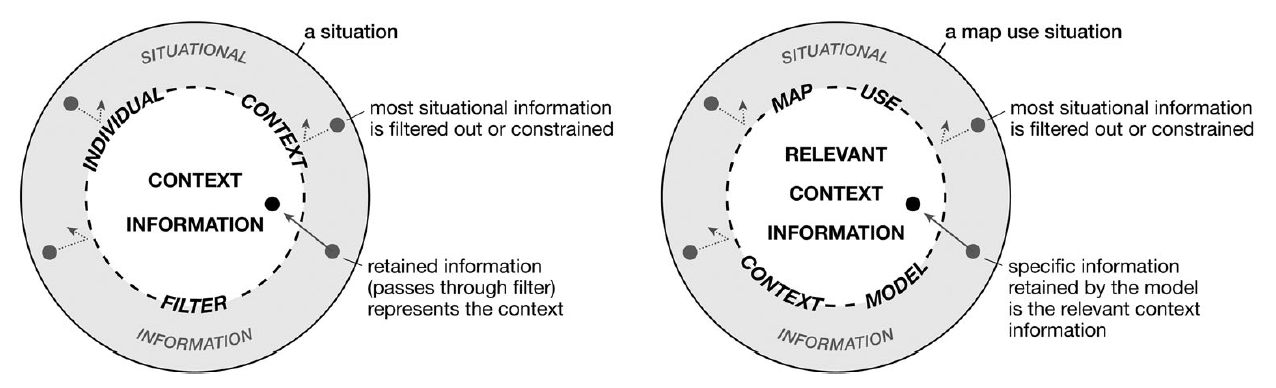
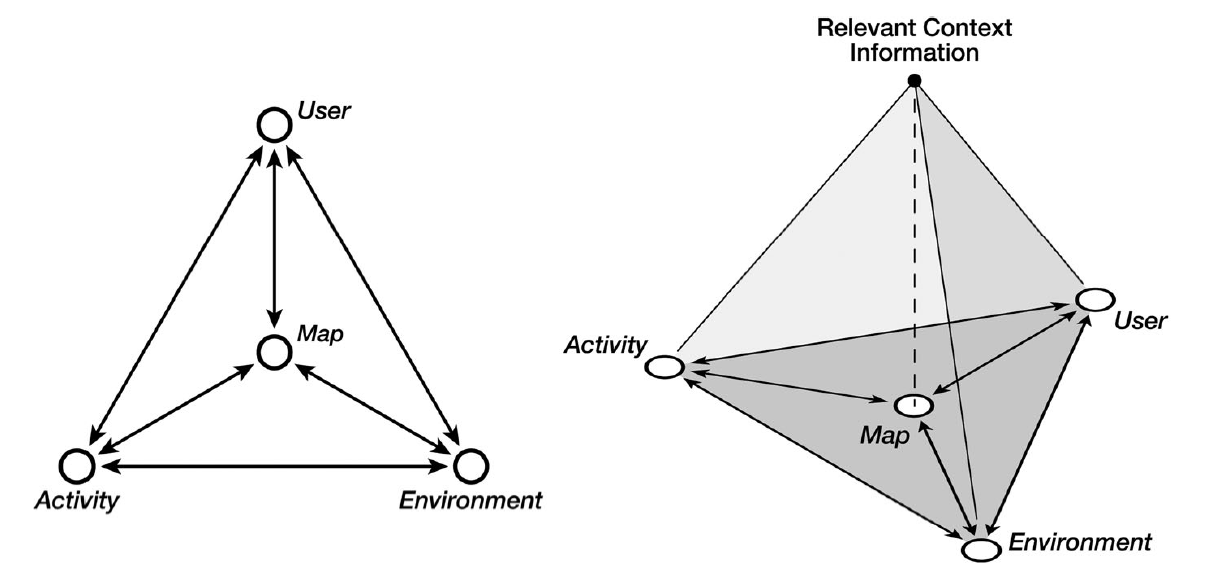
The explosion of map use in the past few decades as part of everyday activities, accelerated through the digital production and dissemination of maps and the availability of low-cost, location-aware devices, has made the job of cartographers and map display designers more challenging. Yet, how do these recent changes affect effective map design? Can we accurately predict which designs will work for a given context? We investigate the concepts of design transferability and context and their potential to help us create map design outcomes that are effective for varying map use situations. We then present a model for operationalizing map use context to support evaluating map design transferability and pose several open research questions that need to be answered to support operationalizing map use context. This is followed by a research agenda that identifies research opportunities related to key research needs that will underpin transferable map design.
Figures
BibTeX
@article{griffin_designingAcrossMapUseContexts_2017,
 abstract = {The explosion of map use in the past few decades as part of everyday activities, accelerated through the digital production and dissemination of maps and the availability of low-cost, location-aware devices, has made the job of cartographers and map display designers more challenging. Yet, how do these recent changes affect effective map design? Can we accurately predict which designs will work for a given context? We investigate the concepts of design transferability and context and their potential to help us create map design outcomes that are effective for varying map use situations. We then present a model for operationalizing map use context to support evaluating map design transferability and pose several open research questions that need to be answered to support operationalizing map use context. This is followed by a research agenda that identifies research opportunities related to key research needs that will underpin transferable map design.},
 author = {Griffin, Amy L. and White, Travis and Fish, Carolyn and Tomio, Beate and Huang, Haosheng and Sluter, Claudia Robbi and Bravo, João Vitor Meza and Fabrikant, Sara I. and Bleisch, Susanne and Yamada, Melissa and Picanço, Péricles},
 doi = {10.1080/23729333.2017.1315988},
 journal = {International Journal of Cartography},
 pages = {90--114},
 title = {Designing across map use contexts: a research agenda},
 url = {https://www.tandfonline.com/doi/full/10.1080/23729333.2017.1315988},
 volume = {3},
 year = {2017}
}